BY MARY-RUSSELL ROBERSON
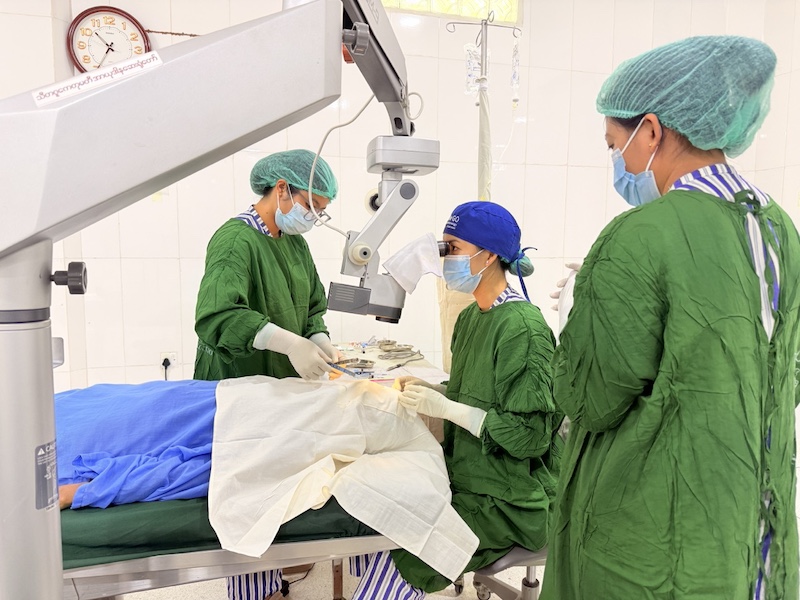
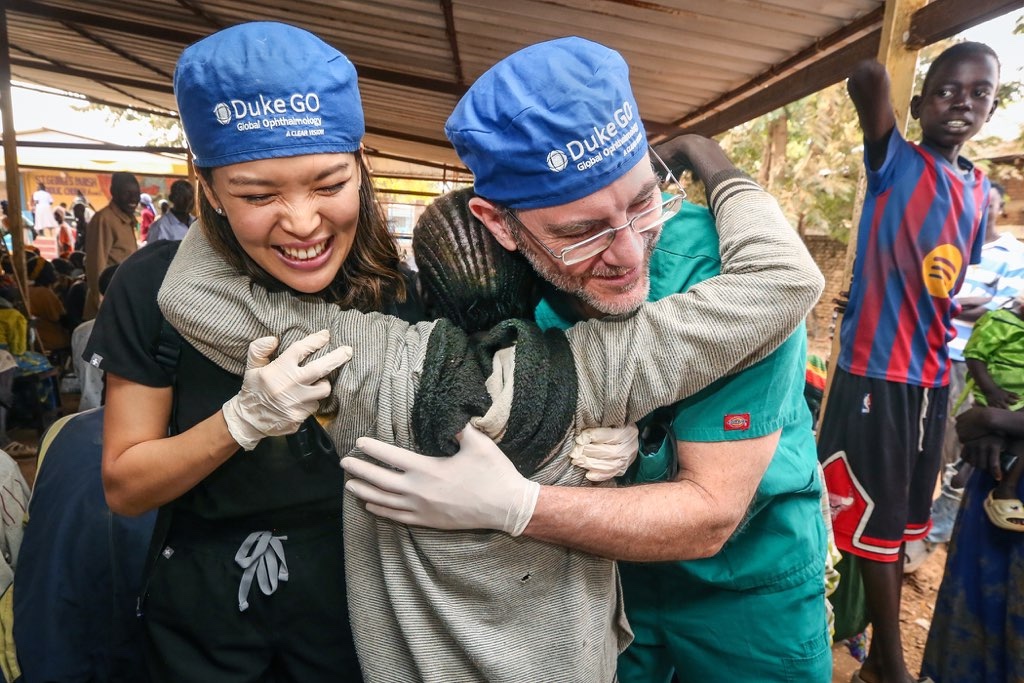
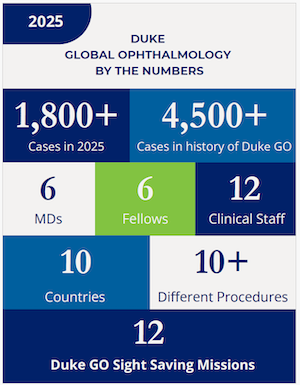
Duke Global Ophthalmology (Duke GO) had another banner year in its mission to cure avoidable blindness in underserved countries around the globe. Director Lloyd Williams, MD, PhD, spends 10–11 weeks each year on global missions performing corneal transplants and cataract surgery to restore sight in countries where such surgeries are not available. He also trains local healthcare providers and helps establish infrastructure for ophthalmic care.
As the child of Lutheran missionaries who were stationed in Papua New Guinea during part of his childhood, Williams said he has always wanted to serve abroad in a medical capacity. “That was my goal from the beginning,” he said. “I always had this idea of seeing the world globally.”
In recognition of his work restoring sight for patients worldwide over the last 20 years, Williams, associate professor of ophthalmology, received the 2025 Outstanding Humanitarian Service Award from the American Academy of Ophthalmology. “My hope is that the award will allow us to do more in global ophthalmology and bring others to the cause so that more and more blind people will see,” he said.
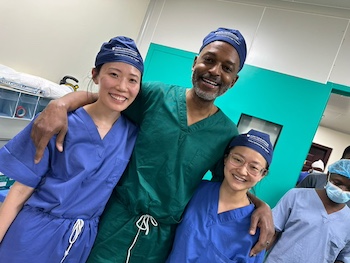
In addition to Williams, Duke GO includes several faculty members committed to curing blindness worldwide. Leon W. Herndon Jr, MD, professor of ophthalmology, and Anupama Horne, MD, associate professor of ophthalmology, along with fellows and clinical teams, traveled abroad on sight-saving missions in 2025. In addition, Duke GO supports other Duke ophthalmologists who travel to help those in need across the globe. This year, Julie Woodward, MD, professor of ophthalmology, and Christopher Boehlke, MD, assistant professor of ophthalmology, participated in missions supported by Duke GO.
Corneal Transplants in Sierra Leone
In 2021, Williams performed Sierra Leone’s first corneal transplant. Since then, he’s performed or assisted in 106 more. Williams brought corneal tissue from the U.S. for each surgery, with support from CorneaGen and Precision Ocular Network (formerly Miracles In Sight), an eye bank network with regional ties to North Carolina. He has also trained physicians in Sierra Leone in the technique to strengthen access to care for the region.
Eye Banks in Indonesia
In Indonesia, Williams has catalyzed and supported the establishment of three new eye banks, again with the assistance of Precision Ocular Network. “Before, there was one eye bank that was producing about 100 tissues a year for a need of 100,000 to 200,000 corneal transplants,” he said. With five tissue banks, more patients can be helped — both today and tomorrow. “It helps those being transplanted but also makes it reasonable for someone there to train to be a corneal transplant surgeon,” he said, “so it increases the number of transplant surgeons.”
Duke’s First Global Ophthalmology Fellow
Williams seeks to multiply his efforts by training surgeons in the countries he visits and by mentoring learners at Duke. This year, with the support of Precision Ocular Network, he launched the Duke Global Ophthalmology Fellowship, a goal of his since he arrived at Duke in 2019. There are fewer than a dozen such fellowships in the country.
“Duke is unique in that our fellowship is a global cornea fellowship,” he said. “That means the person graduates as a cornea fellow in addition to the global experience. The Duke fellowship is a very individualized program dedicated to the goals of the fellow. The places we go and the surgeries we study will change with each fellow as per what they need to work on.”
The first fellow, Sheena Song, DO, has already traveled with Williams to Guyana, Indonesia, North Macedonia, Myanmar, and South Sudan. In the spring, she’ll be traveling to Sierra Leone, Honduras, Jamaica, and back to Guyana and Indonesia, as well as other planned trips.
Growing up, Song frequently visited Thailand and the Philippines and became intrigued with the idea of working internationally. As a college student, she went on a vision screening trip to Guatemala with a group of optometrists. “After that, I was hooked,” she said. “I knew I wanted global ophthalmology to be the centerpiece of my career.”
Not only is Song learning technical skills, such as surgical techniques for low-resource settings, she is also learning soft skills related to interacting with patients and providers from different cultures and backgrounds.
“Dr. Williams is a visionary and lives and breathes global ophthalmology so I couldn’t imagine a better role model to learn from,” she said.