
Author: Mary-Russell Roberson
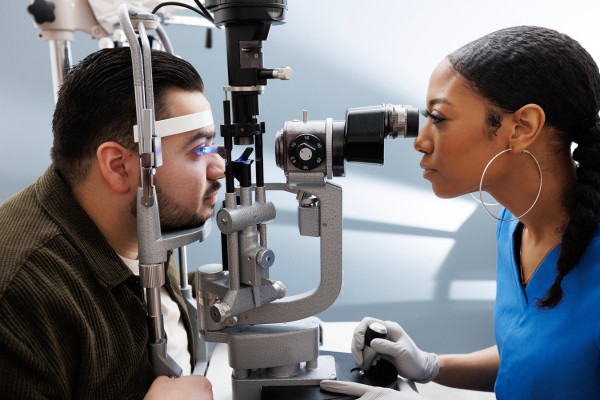
For almost 40 years, the Duke Ophthalmic Technician Program has trained students to take patient history, check vision acuity, measure eye pressure, and work in countless other ways as effective team members to provide necessary diagnostic information for ophthalmologists to diagnose and manage eye diseases.
“Ophthalmology is very different from other aspects of medicine, so a unique skillset is required for ophthalmic technicians,” said Adam Moses, COMT, who directs the program. “There aren’t enough people trained and it’s a field with a growing demand.”
Moses said Duke’s program offers several advantages over other programs. One is that students complete their coursework and rotations in just one year instead of two. The first three months students spend all day learning in the classroom as well as practicing clinical skills in the simulated examination area. For the remaining nine months, students rotate through the Duke Eye Center’s eight clinics, pairing up with experienced mentors as they learn about various subspecialties, such as glaucoma, retina, cornea, and pediatrics.
Another advantage of the program is that students have access to Duke’s cutting-edge resources, including facilities and equipment, as well as the expertise of Duke Eye Center faculty and staff.
After graduating, students are eligible to sit for a certification exam administered by the International Joint Commission on Allied Health Personnel in Ophthalmology, which includes a written test and a skills exam.
Mikayla Davis, a current student in the program, was to drawn to the field because of her own experience with eye problems. “I’ve been a patient of the Duke Eye Center since I was 12,” said Davis. “I know for me personally having technicians that care about you make the tough appointments bearable” Davis has several eye conditions, including inflammation in her eyes, a swollen optic nerve, and dry eyes.
“This program gives us the best chance to learn all we can in a year, to really prepare us well and set us apart,” she said. “I like to be the best I can be at everything, so this program made the most sense.”
Another current student, Ticora Jones-Greene, also became interested in Duke’s ophthalmic technician program as a Duke Eye Center patient. She was 16 at the time, and was intrigued by what the ophthalmic technician was doing while at her appointment. When she started asking questions, the technician gave her a brochure about the program and encouraged her to apply. She was too young then – applicants need to be at least 18 and have a high school diploma – but she kept the idea in mind for years.
Now, as she is mastering the skills, Jones-Greene’s initial interest has turned into something deeper. “As an ophthalmic technician, you play a crucial role,” she said. “It’s rewarding and you have a sense of purpose.”
As the mother of a three-year-old son, Jones-Greene appreciates the schedule of the program, which takes place during working hours on weekdays. She also enjoys the way the curriculum is organized. “I love Adam’s approach of teaching the building blocks: we learn about a skill and then we go do it and experience it in real time,” she said.
Perhaps most of all, Jones-Greene values the opportunity to learn and thrive with the support of her teachers and mentors. “This program has changed my life,” she said. “I’ve made amazing connections along the way with surgeons, doctors, and techs. They are always looking to teach you and help you grow.”
The Duke Ophthalmic Technician Program is always accepting applications.