
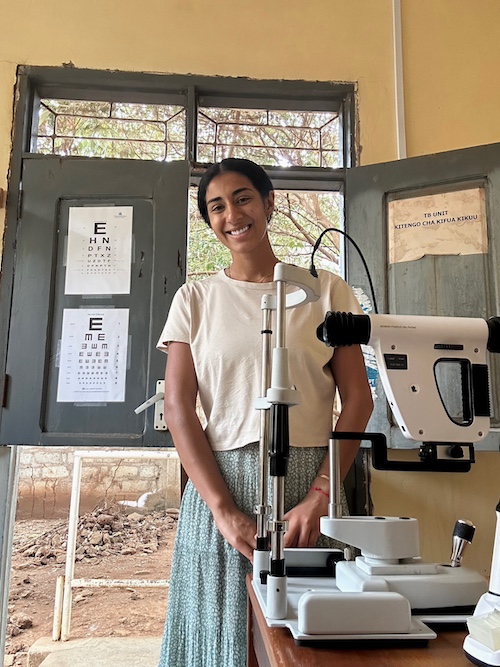
Duke University School of Medicine third‑year medical student Arthi Vaidyanathan devoted eight months of her research year to Moshi, Tanzania, working to better understand and address the eye care needs of people living with HIV.
Supported by the NIH Fogarty International Center, the Duke Global Health Institute, Duke Global Ophthalmology (Duke GO), and guided by mentors Lloyd Williams, MD, PhD, and Leon W. Herndon Jr, MD, Vaidyanathan set out to explore how eye disease presents in this population today.
“I am proud to support Arthi during her research year. Her work is the heart and soul of our mission. She embodies the importance of global ophthalmology, and I look forward to the outcomes of her project and the impact she will make throughout her career,” said Williams.
Since the introduction of antiretroviral therapy, the landscape of HIV‑related eye conditions has changed significantly. Yet across sub‑Saharan Africa, the true burden of eye disease among people living with HIV remains poorly defined.
Understanding which conditions are most common and if they are being detected during routine care is crucial to improving long‑term vision outcomes. As an NIH Fogarty Global Health Fellow, Vaidyanathan is integrating comprehensive eye screening into three HIV clinics in Moshi. Her work includes visual acuity checks, symptom screening, handheld fundus photography, and intraocular pressure measurements.
“My hope is that this work will offer a clearer picture of the eye health needs of people living with HIV in Tanzania, help HIV clinics recognize eye concerns earlier, and strengthen referral systems,” Vaidyanathan said.
The project aims to enroll 250 patients. To date, the team has screened 70 individuals and referred more than 20 patients for follow‑up care at a local eye hospital. Vaidyanathan has spent time in the local eye department, seeing firsthand how clinicians deliver care and how screening efforts can influence a patient’s path to treatment.
Her months in Tanzania have also been personally transformative, stretching her to adapt, problem‑solve, and embrace the unexpected.
“I’m grateful for the experiences that have shaped how I think about partnership, resourcefulness, and patient‑centered care,” she shared. “And I’m especially grateful to Duke GO for supporting this project and giving me the chance to learn from leaders in global ophthalmology like Drs. Williams and Herndon.”