
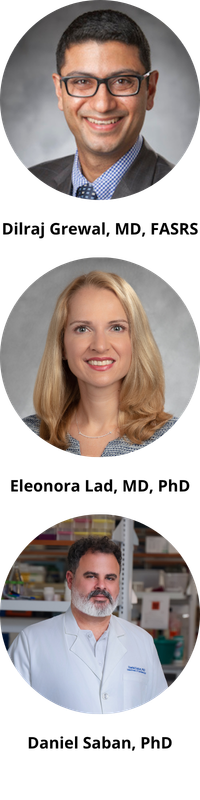
Duke Eye Center is pioneering a transformative initiative that blends data, expertise, and artificial intelligence (AI) to redefine precision ophthalmology. This effort is more than a database — it’s an AI-powered data ecosystem designed to integrate diverse data types from clinicians, biologists, and computational scientists to unlock new possibilities in diagnosis, treatment, and research.
“With technologies like RNA sequencing, spectral flow cytometry, and advanced ocular imaging, we’re talking about billions of data points,” said Daniel Saban, PhD, Joseph A.C. Wadsworth Distinguished Professor of Ophthalmology. “That’s where AI comes into play.”
Machine-learning algorithms will mine this vast information for patterns and signals, helping clinicians diagnose patients faster and monitor treatment effectiveness with unprecedented precision. Beyond clinical care, the ecosystem will serve as a rich resource for research into
disease mechanisms and biomarkers. “Data paired with expertise could powerfully change the standard of care, especially for difficult to diagnose and difficult to treat conditions,” said Eleonora Lad, MD, PhD, vice chair of clinical research. “It could revolutionize personalized medicine.”
Helping Clinicians with Diagnosis and Treatment
The initial focus is on two challenging conditions: uveitis and ocular surface disease, including dry eye. Uveitis, an inflammation of the eye’s middle layer, can stem from autoimmune disorders, infections, or even lymphoma — three causes requiring vastly different treatments. When the underlying cause isn’t clear, clinicians face hurdles: collecting eye fluid requires surgery, yields only tiny samples, and can delay diagnosis for months. “Diagnosis can take upwards of a year, meanwhile the disease is progressing,” Saban explained.
Even after diagnosis, treatment can be a long road. Some patients don’t respond to first-line therapies, and trial-and-error approaches can take weeks or months — time that’s critical when vision is at stake. “That becomes really tragic when somebody is losing their vision,” Saban said.
Dilraj Grewal, MD, professor of ophthalmology and associate director of the Duke Reading Center, sees the project as a game-changer. “It’s addressing an unmet need in these difficult to manage eyes,” he said. “AI can help us come up with cleaner signals that can direct the patient’s treatment at an earlier stage, helping to preserve more vision.” While imaging advancements have improved diagnosis and monitoring, Grewal noted a missing link: connecting the myriad of imaging data to molecular profiles. “That’s where this ecosystem shines.”
Billions and Billions of Data Points
Laboratory tools and techniques to analyze cells have also come a long way. Researchers like Saban use RNA sequencing to measure the gene expression of individual cells, and spectral flow cytometry to measure dozens of protein markers for individual cells. The result is that one small biological sample can yield billions of data points. “Essentially, the more data points we have, the harder it is for us to analyze,” Saban said. “Now with these [computer] programs, [the amount of data] is no longer a curse. It’s a benefit.”
Computational biologists can wield AI and machine learning to integrate and analyze massive amounts of data, identifying patterns that have been previously overlooked. In contrast to algorithms that are trained on existing datasets, this kind of AI undergoes no human training before it begins looking for signals and relationships. In other words, the algorithm generates hypotheses as opposed to the more traditional scientific method where scientists generate hypotheses and test them with data. Saban said the approach is called unbiased data-driven science. “The computer tells us what is unique about the data,” Saban said.
Saban said that researchers beyond those who have contributed to the ecosystem will be invited to make use of it, multiplying the pace of discovery.
The team has demonstrated the data ecosystem using a small sample of patients and found that the algorithm produced preliminary useful results. They are now working to grow the project to include more patients and conditions, and to collaborate with other institutions and organizations.
The Duke Advantage
Duke ophthalmology is a natural home and well-positioned to take on this initiative. Saban and Lad point to the department’s collaborative culture and depth of expertise.
“Our approach is really powerful,” Saban said. “I’m interacting with doctors who are seeing patients, using cutting-edge biological assays, and working with computational biologists who can distill what’s happening.”
Lad added, “We have a track record of collaborating internally and with foundations and companies so we can execute really well on this type of initiative.”
With a large patient base, world-class ophthalmologists, and advanced tools, Duke is uniquely positioned to lead this revolution in personalized eye care.
This AI-powered data ecosystem represents a bold step toward a future where ophthalmic care is faster, smarter, and truly personalized. By harnessing billions of data points and the power of machine learning, this initiative promises not only to improve outcomes for today’s patients but also to accelerate discoveries that will shape the future standard of care.
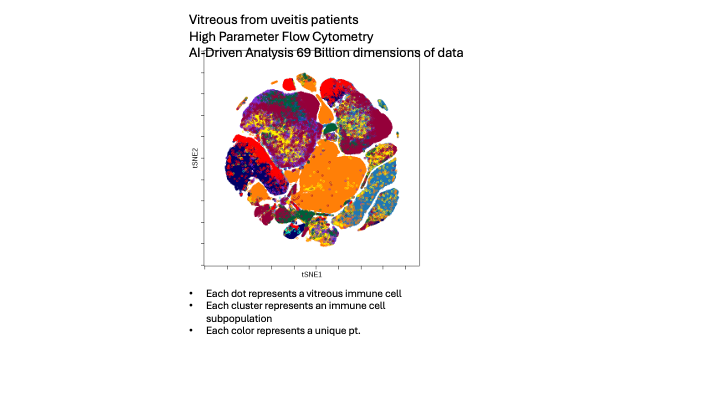
High Parameter Flow Cytometry
AI-Driven analysis 69 billion dimensions of data